Module 3
“Yes means No”
—
An extract from Arboretum by David Byrne, recommended by Elio Salichs
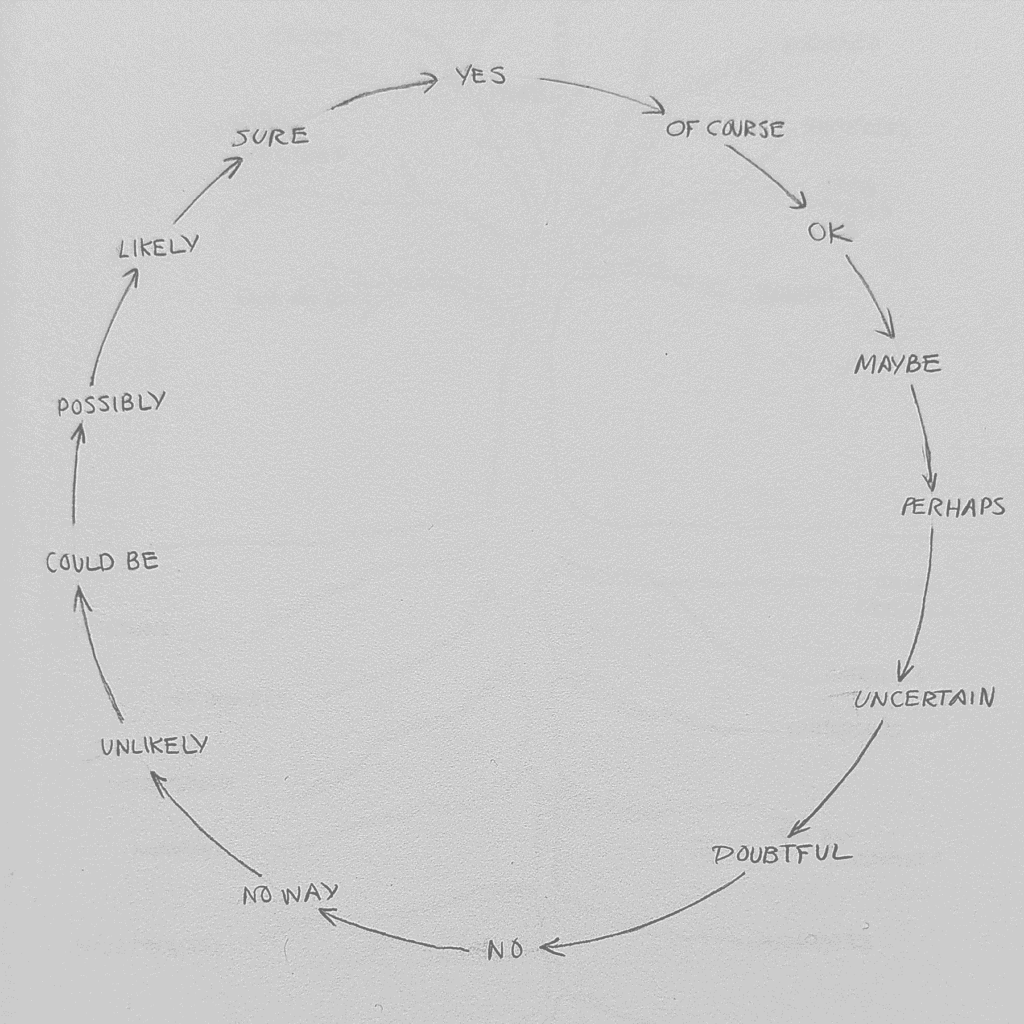
The book Arboretum, by David Byrne, is a collection of drawings and diagrams that function as “mental maps of imaginary territories,” evolutionary trees, or fictional and improbable classifications. Byrne organizes ideas, obsessions, and cultural relationships as if he were trying to map the intangible. He draws these diagrams based on a very personal logical system that could be described as “irrational logic” — which allows him to make unexpected connections and arrive at new and surprising meanings.
About Yes means No drawing, Byrne says: “The boundary between yes and no isn’t sharp. There are many shades in between: maybe, possibly, uncertain, doubtful but perhaps. And these positions are not fixed. They shift over time — what feels like a no can turn into a yes, and the other way around. The whole spectrum is in motion.”
Reflections from Elio:
Questions that I am responding to:
3.2 What can we learn from interdisciplinary case studies?
3.3 What can design bring to collaborative workspaces?
4.1 Can we reframe cognitive dissonance as a superpower?
4.2 What would a design brief say in a world that made sense?
4.3 How can designers be creatively strategic?
The relationship between this text and Elio:
I first read David Byrne many years ago, with his book Bicycle Diaries. Even then, I found Byrne’s fluid connections of apparently unrelated themes and his lucid observations on urban life fascinating. Besides, we both enjoy getting around our cities by bicycle. The diagram Yes means No makes me think of many things. In this MA context, it takes me straight to the design process, the final outcome, and classroom dynamics—the tension between simplicity vs complexity, and that non-linear path vs clarity.
Why is this relevant?
To me, “yes” and “no” can feel too rigid—almost arrogant—when presented as absolutes. It’s not that they don’t exist, but I feel we are often pushed to choose in between them too early. Maybe design is more than just following a brief. I see it as a process of relating, mapping, and doubting. Some students look for clear answers and clarity from the start, but in my experience, there is a stage of intuition and connection that we aren’t quite able to put into words yet.
Questions for the students:
- What do you think of this visual?
- What inspirations can you draw from it?
- How do you map something you don’t fully understand?
- If you don’t rush to clarity, what could appear?
- How could this way of thinking influence how humans relate to each other?